Scientific objectives and context
UMMISCO develops models to describe, explain and explore scenarios for the evolution of complex socio-environmental systems. The emphasis placed in recent years on the participation and involvement of stakeholders and citizens means that these scenarios need to be better mediated and shared, whether during the construction of the models that generate them, during their simulations, or during the exploration of alternative models. These so-called “participatory” or “citizen” approaches raise scientific and technological challenges that UMMISCO 4 wishes to focus on, with the aim of providing methodological support for the transdisciplinarity so dear to the science of sustainability. Indeed, beyond interdisciplinarity, some of the models developed by UMMISCO (mentioned in theme 1) are part of explicitly transdisciplinary approaches, mobilizing players who are not necessarily scientists for their design, use or exploration.
These models then become supports for participative approaches and forward-looking thinking, in which stakeholder intervention is taken into account like all other dynamics (ecological, biological, physical, etc.). They support activities more geared towards knowledge transmission, mediation, communication, co-creation or consultation, and thus become a representation of reality that plays the role of a common ground where scientists, stakeholders, decision-makers and the general public can interact, discuss and negotiate about their shared future. At the other end of the spectrum, in close connection with theme 3, participatory approaches (in this case including “citizen science” or “crowdsourcing” approaches) are becoming a new mode of knowledge or complementary data production, enabling models to be fed with more qualitative data, often more closely linked to stakeholder behaviours. The unit therefore wishes to explore the impact and interest of new forms of participation such as involvement and information gathering via tangible interfaces, as well as understanding the contribution of ludification (use of game mechanisms) to foster learning, mediation or decision-making situations. This theme will also be an opportunity to forge deeper and perhaps more formal links with institutions or groups with which UMMISCO has worked in the past, such as the COMMOD network, LPI or the MIT Media Lab.
While all modelling-related approaches (participatory modelling, participatory simulation, simulation-based serious games) have been made possible by the development of new simulation platforms, in particular agent-based platforms, it has to be said that they are still not widely used, as their design requires specific expertise and their implementation requires particular methodologies. Indeed, depending on the objectives assigned to them, which range from disseminating scientific culture to involving civil society in research, innovation and even decision-making processes, they are characterized by a wide diversity of approaches, disciplines and players, whose forms of commitment (voluntary, remunerated, individual or collective, etc.), role (protocol establishment, collection, analysis, interpretation, etc.) or status (beginners, specialists, students, general public, etc.) can also vary greatly. These two points, around expertise in designing participatory systems and methodology for implementing these systems, represent the two main obstacles that the unit will strive to overcome by creating this new theme and encouraging the development of dedicated research and applications, in close liaison with the other 3 themes, particularly with regard to fields of application.
In order to deal with them in the best possible way, particular emphasis will be placed on the development of new interfaces that, on the one hand, facilitate the involvement of non-scientists by making interaction with models more natural and less intimidating, and, on the other hand, enable the “natural” collection of data from them, particularly qualitative data (behavioral, decisional, etc.). These new “man-model interfaces” should enable users to explore a range of possible ramifications from well-defined scenarios, some of these ramifications being obtained «classically» by application of stochastic models, for example, and others being the result of intervention by these same users in the course of the simulations. We therefore need to envisage user-model relationships that are no longer passive, but can instead be based on different forms of interactivity or interaction, depending on the model, the age or the culture of the user. Interface means, in particular (but not only) visualization. Visualizing the execution of a model (i.e., a simulation or set of simulations based on this model) plays a crucial role in a user's ability to apprehend the dynamics at work in this model: the emergence of spatio-temporal regularities, events occurring at the end of specific percolations, etc. It is often the most immediate means of visualizing a model's execution. It is often the most immediately accessible means of orienting a more detailed analysis at a later date, as in many cases it represents the only possibility of observation available to the user. The work envisaged is based on the hypothesis that the techniques available for visualizing the execution of a model play a crucial role in users' ability to extract abstract information essential to the purpose for which the model was designed, or to discover dynamics not otherwise perceptible. The theme will therefore encourage the exploration of all the possibilities offered by modern visualization environments to test and propose solutions that draw on interactive 2D and 3D environments (metaverses, massively multiplayer online role-playing games, etc.), tangible interfaces (Grignard et al. 2020) but also, beyond the technical, on abstraction, synthesis or learning mechanisms, to obtain flexible and adaptive interfaces.
The graphical representation of data (whether from simulations or any other process) is not a recent field of research, but the coupling between graphical representation and interaction mechanisms has proved extremely fertile, and technical developments (touch interfaces, 3D visualization, etc.) are opening up new areas of research concerning the interactive visualization of complex models. What's more, in a participatory science approach, it is crucial to be able to provide stakeholders with action capabilities on simulations that are simple to use, easy to describe and capable of adapting to different possible scenarios. From a technical point of view, the theme will therefore encourage research into avenues still uncommon in the field of sustainability science, but which seem particularly promising for encouraging interaction between stakeholders and models, such as combinations of tangible interfaces (in the form of models) and augmented reality.
The theme will organize research within the unit by favoring a pragmatic, experimental and progressive approach, in particular by systematically drawing on the applications developed by UMMISCO in its various centers, on the occasion of experiments with «real» users (i.e. social actors, decision-makers, users...). The idea, therefore, is not necessarily to create new applications or new projects, at least not immediately, but rather to provide the best possible support for existing applications and to draw lessons from them with a methodological vocation, enabling us to generalize interface or support systems.
- Gamification and serious games. A good example of what the unit intends to promote in this theme is the RÁC13 project. This is a serious multi-player game designed within the LMI ACROSS, attached to UMMISCO in Vietnam, to raise users“ awareness of the impact of solid and liquid pollution on irrigation systems. Its aim is to encourage social dialogue between the various players involved, in order to arrive at concerted solutions. The game follows the evolution of waste management and agricultural production in the fictitious territory of a rural commune, divided into four villages, each facing specific problems due to its situation. 4 groups of players decide on local actions to achieve the objective of maintaining global quality certification for the rice produced by the commune. Players are thus invited not only to improve their own situation, but also to coordinate their actions to promote collective action. To this end, users are provided with action cards, which they can play each turn https://across-lab.org/application/red-river-delta-bac-hung-hai-irrigation-system/; ”RÁC“ means ”waste" in Vietnamese.
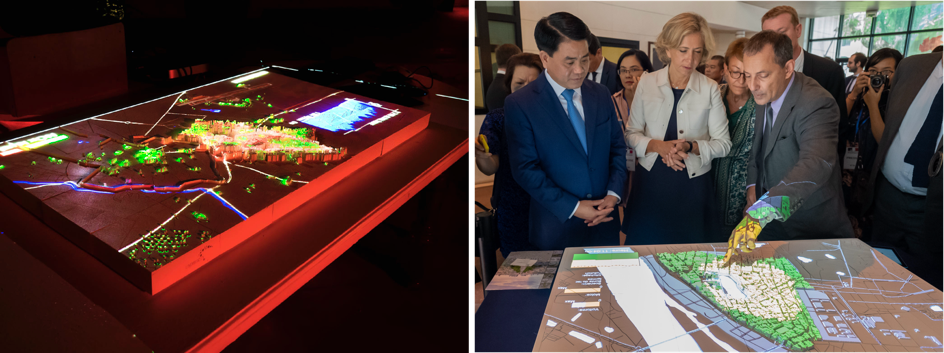
(canal cleaning, awareness campaigns, financial incentives to reduce fertilizer use, etc.) and a shared model that simulates the evolution of the territory and allows players to observe the consequences of their actions. RÁC has been played in two contexts: with secondary school students, and with farmers and village chiefs. - Tangible interfaces. A tangible interface is a user interface by means of which one or more users can visualize and interact with the information produced by simulations via a physical device (normally dedicated to the model, e.g. a 3D model of the simulated environment). These devices, coupled with artificial intelligence, represent a radically new decision-making or mediation tool for the various stakeholders. In particular, it can be used to explore, visualize and share new planning strategies or development scenarios, in order to assess the extent to which they correspond to the needs of stakeholders sharing this dynamic representation. This coupling of computer models with tangible interfaces has been experimented with by UMMISCO in recent years in projects such as HoanKiemAir (Duc et al. 2020), Bac Hung Hai (Grignard 2020) or MarraKair (Emery et al. 2017) and, in a broader framework, within the CityScope project (in which UMMISCO is involved through GAMA, with the MIT Media Lab's CityScience14 group) or in urban mediation research-training workshops as part of the Ecole de l'anthropocène (Andry et al. 2022). The unit hopes to continue developing and improving these approaches in new projects such as Ocean Park Air, supported by VinUniversity as part of the “Digital Twin Platform to Empower Communities for Eco-friendly environment” project, or Moov'Hanoi in partnership with AFD and Paris Région Expertise, which involves studying and communicating the development policies of the public transport network through an interactive model. Halfway between a serious game and a tangible interface, the LittoSIM platform (Becu and Rulier, 2018; Monfort et al. 2020; Laatabi et al., 2022) has been developed to raise awareness among decision-makers and planners of good coastal management practices in the face of the risks of https://www.media.mit.edu/groups/city-science/overview/
submergence, enabling them to test alternative methods of land management and to collectively design a territorial policy. Participants are immersed in an environment that is both “digital”, representative of their daily lives, and “physical”, for the workshop's scenarization and realism. Originally designed for the island of Oléron (Communauté de Communes de l'Ile d'Oléron project), LittoSIM has found several applications in France (Projet LittoSIM15, Fondation de France), Vietnam (Projet LittoKong) and now Madagascar (Projet Didem, FFEM).
- Virtual reality and augmented reality. Mainly explored for the time being in the SIMPLE project, these new forms of interface have the enormous advantage of allowing users to be fully immersed in virtual environments. The unit is keen to explore their impact on learning, awareness-raising and mediation processes, particularly in relation to a wider, younger audience than with other devices. Thus, the general objective of SIMPLE, funded by the EU as part of a partnership with ASEAN and implemented in the four Lower Mekong countries (Cambodia, Laos, Thailand and Vietnam), is to raise awareness among young people aged 12 to 18 of the sustainability of solutions for preventing or mitigating environmental problems such as the loss of biodiversity in forests or the subsidence of deltas, by developing, testing and offering virtual reality «worlds» coupled with serious games and simulations of these phenomena. The project will be validated by large-scale experimentation in a number of secondary schools in the four countries of implementation.
In addition to the internal and cross-disciplinary leadership tasks devolved to all UMMISCO 4 themes, this theme will aim to build bridges - in particular methodological ones - with other players strongly involved in transdisciplinary approaches, foremost among which will be the LPI and the MIT Media Lab's CityScience team. Indeed, back in 2022, we initiated exchanges with LPI16, through its founder, François Taddei (member of IRD's COS). The discussions that followed, the setting up of projects (such as ViPartiCity, submitted with five Vietnamese partners to the Botnar Foundation), the organization of training courses (GAMA training course in April 2023) and other joint activities have enabled interesting synergies to emerge on participatory and citizen-based approaches supported by innovative digital tools, which we will continue and extend in UMMISCO 4. Indeed, LPI's NGO status enables it to help adopt and experiment with new research and social innovation methodologies, while ensuring that scientific activities remain aligned with the needs and values of the communities involved, thus bringing significant added value to the realization of this theme. As mentioned in relation to tangible interfaces, this theme also involves close collaboration with the MIT Media Lab's CityScience team. The development of several joint projects since 2016 (Grignard et al. 2018) within the CityScope platform (Alonso 2018), focusing on different aspects of scientific innovation and citizen engagement (Noyman 2017), have indeed highlighted highly complementary expertise that we wish to continue combining around themes related to sustainable, resilient and inclusive urbanism. Their work on urban modeling and participatory design, as well as their expertise in digital fabrication and rapid prototyping to develop customized tools and devices, would in any case add an extra dimension, integrating data collected by the public into dynamic urban models to better understand the complex interactions between populations, infrastructures and the environment.