

The West Africa Center will draw on its historical mentor, Cheikh Anta Diop University, to develop methods, knowledge and tools to study the dynamics of Sahelian socio-ecosystems, and thus support stakeholders in their understanding of these complex systems. Its research activities will be structured according to the unit's future themes:
Mathematical and Agent-Based Modelling
Mathematical and computer modelling has been particularly highlighted recently, especially during the Covid 19 pandemic, but also in the work of the IPCC and, more implicitly, in sustainable development foresight work. This highlight has underlined the importance of modeling activities in all scientific fields, but also highlighted certain difficulties in implementing them, demonstrating the need to constantly improve and develop these methods, to clarify their theoretical foundations, and to disseminate new knowledge in mathematics and computer science, while firmly anchoring them in the themes for which they were invented. The theme brings together activities in the unit's historical areas of expertise in dynamical systems, both in mathematics (modeling based on systems of differential equations) and computer science (agent-based models). The aim of this theme is to ensure the scientific monitoring, creation and dissemination of new knowledge both within the unit and in the research communities to which we are linked, and to propose modeling approaches adapted to the issues raised for sustainable development applications. It draws on a network of highly diversified expertise to ensure that methods and points of view relating to the same project are complementary, and to encourage dialogue between researchers from different centers.
Scientific objectives and background
We aim to contribute to the creation of tools for studying the mechanisms and workings of evolving systems (e.g. ecosystems, epidemic propagation), as well as for projecting future system states, which can then be integrated into decision-making tools (e.g. defining policies for sustainable fishing, estimating the number of people infected during an epidemic). In particular, in the context of complex systems and the modeling of large-scale systems, we approach problems at different levels of granularity, which is made possible by the diversity of our know-how. For example, we are tackling epidemiological problems on a local and individual scale, for the propagation of an epidemic within a building or neighborhood using agent-based modeling (COMOKIT project, Taillandier et al. 2024), as well as on a national scale to propose methods for mitigating epidemics or quantifying health system interventions. This knowledge base enables us to pay particular attention to problems of scale, and to develop techniques for analyzing and reducing the complexity of large-scale systems, as well as for interconnecting models at different scales via hybridization techniques. More specifically, the theoretical approaches we wish to continue developing concern dynamic systems in mathematics (systems of ordinary or stochastic differential equations, partial differential equations, delay equations, finite difference equations, semi-groups, optimal control theory) and agent-based modeling in computer science. The main thrusts of the scientific project linked to this theme are, from the most fundamental to the most applied:
- Contribute to the science of complex models by developing analysis or simplification methods to make more efficient use of the models we build (variable aggregation methods in continuous space, inverse problem-solving methods, identifiability, observability and optimal control, or to highlight properties of certain large-scale systems (emergence phenomena). Model integration and coupling (hybridization) to assemble pre-existing models or create multi-scale models (epidemiology, transport).
- Development of explanatory models to address certain general issues (e.g. study of the effects of environmental heterogeneity on fisheries yields and Maximum Sustainable Yield, or studies of collective dynamics (Bellomo et al. 2022)).
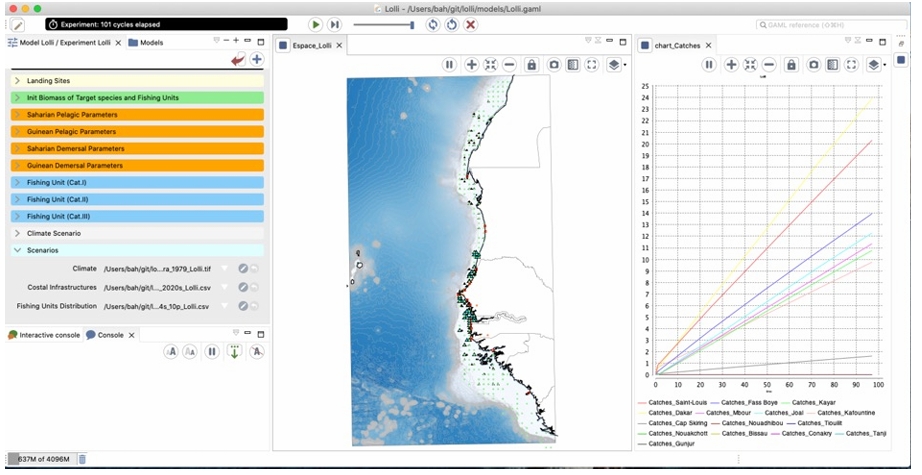
- Development of open-source tools, platforms and libraries (GAMA5 agent-based modeling platform, COMOKIT6 platform dedicated to epidemiological modeling), dedicated languages, model creation tools (integration of AI for programming assistance) and their use by specific communities. Development of tools dedicated to certain applications (e.g. 3D representation of soil pores for analysis of microbial dynamics in soil pores).
- Applications of these methods to socio-environmental, ecological and sustainable development issues, as described below.
This theme faces a number of scientific hurdles:
- Conceptual challenges: some problems require the development or even the creation of new methods in line with axis (i), particularly for high-dimensional systems and multi-scale models. For example, methods for aggregating variables have not yet benefited from major developments in continuous space (reduction of PDE systems to less complex EDO systems that are more frugal in terms of computing power), which is necessary to tackle certain problems of chemotaxis, morphogenesis or population dynamics (El Harrak et al. 2021). The integration/coupling of models, and the realization of multi-scale models (slow/fast systems, spatial scales) require the creation of conceptual and technical frameworks enabling seemingly contradictory elements to cohabit (for example, for the hybridization of mathematical/computational models: how can spatial variability be reconstructed from mean-field models?).
- Technical challenges: the models we are studying can be very resource-intensive, especially when many simulations need to be explored. To remedy this, optimization methods need to be developed. For example, on the GAMA platform, a number of challenges remain, notably with regard to agent synchronization and data concurrency during simulation parallelization (Grosjean et al. 2024). In addition, the development of means to dynamically link or calibrate models to updated field data is proving increasingly necessary, as this not only ensures greater model consistency, but also boosts the confidence of thematicians and practitioners in the use of modeling. Finally, we aim to make the tools we develop easier to use, in particular by using the latest advances in generative AI, which should make it possible to create wizards for creating and coding models, thus removing the lock preventing non-computer scientists from getting involved.
- Absence, lack or inconsistency of data: one of the main constraints of “Science in the South” as practiced by UMMISCO is the inadequacy of data to achieve research objectives. Data may be non-existent due to the absence of collection campaigns or lack of resources (fisheries data), too old (absence of recent mobility data in certain southern countries), or inaccessible due to local rules and the fact that they constitute a resource, rarely available in open data. So, when synergy with theme 3 doesn't allow us to increase data availability, we need to develop alternative low-data science methods. This can take several forms, such as reconstructing synthetic data, generating synthetic populations (Chapuis et al. 2018) or adapting mean-field methods to parcel-based datasets.
The methods developed within this theme are used to address socio-environmental, ecological and sustainable development issues, which can be grouped into three categories: Population dynamics, biology and epidemiology. Population dynamics is concerned with the modeling of animal populations and ecosystems. We can mention, for example, work on agent-based modeling of invasive species (particularly rodents, (Moussa et al. 2019)), or those linked to epidemiology on the impact of animal migration on rift valley fever, for which a simulator has been produced (Python Ndekou Tandong et al. 2020).
Epidemiological modeling was in great demand before, during and after the Covid-19 pandemic, both in mathematics (e.g. recommendations for epidemic mitigation strategies (Nguyen Huu et al. 2023; Bacaër 2021; Cazelles et al. 2021) and in agent-based modeling (COMOKIT project, modeling kit for strategy analysis and comparison (Gaudou et al. 2020)). The NOCIME7 project (ANR), which began in 2024, focuses on the use of optimal control methods for mathematical models used in epidemiology, taking into account the characteristics of epidemiological systems, notably the stochastic components, both in the processes involved and in the observations. In most centers, and particularly in Cameroon, emphasis will also be placed on One Health approaches, integrated and unifying approaches which aim to consider the health of people, animals and ecosystems, without separating the scientific fields involved, and which raise important methodological questions in terms of model coupling and scales. In biology, mathematical modeling work on tumor growth is being carried out in the Mediterranean center. With regard to soil biology, we can cite the CAMMiSolE project, dedicated to the effects of global change in West Africa and Madagascar on the diversity of soil microorganisms (Razanamalala et al. 2018), the MAS2MIC project aimed at designing a participatory, multi-actor platform for testing agricultural technical itineraries on a landscape scale (L. Dunn et al. 2021), or work on soil biology, for which tools for geometric modeling of pore spaces based on tomographic images are being developed (Monga et al. 2022).
Water resources, food resources, fisheries. The production of food resources and the sustainability of water resources are threatened by the development of human activities and the effects of climate change. These issues are being addressed by our various partners' research centers: Sahelian agro-sylvopastoral systems in a context of climate change in West Africa, bio-economy of fisheries in Senegal, North Africa and Vietnam (Brochier et al. 2021): identification of conditions for increasing Maximum Sustainable Yield (Nguyen et al., submitted), study of the optimal placement of Marine Protected Areas (Ghouali 2022). A project on the development of sustainable and equitable offshore anchovy fishing and optimization of value chains near Phu Quoc Island off the Mekong Delta has just been submitted for funding by the Global Centre on Biodiversity for Climate (GCBC). The Red River Delta, whose central area is the Bac Hung Hai region (Red River Delta) in northern Vietnam, a large agricultural region irrigated by a major canal network, is also a field of study for the unit's researchers as part of the LMI ACROSS8 , associated with UMMISCO since 2021. The study of water supply issues in this vast system is approached through hybrid modelling approaches between mathematical models (describing the system's hydrodynamic process) and agent-based models (describing the behaviours and interactions of the system's actors), enabling the multiple aspects linked to the sustainable and participatory management of irrigation systems to be addressed with all the necessary richness (Chien 2018).
With regard to food security, the EU-funded, FAO-led STAR FARM project, which started in 2024, addresses the possibility of developing more sustainable agri-food systems in the Mekong Delta, based on the adoption, at small and large scales, of agro-ecological practices and on an in-depth study of their impacts on soil health, value chains and carbon emissions. UMMISCO's role in this project will be to build an aggregate model that will (1) bring together data produced by IRD and other partners on the social, agricultural, economic, biological, climatic and hydrological aspects of the case studies under consideration; (2) to understand and measure, through simulations exploring specific scenarios at different scales (from plot to province), the relevance of certain crop choices on biodiversity conservation, improved living conditions, greenhouse gas production and adaptation to climate change. Urban dynamics, traffic and pollution. The rapid development of cities in the South generates a need for planning and projection that local decision-makers do not always have the technical, human and financial resources to implement. UMMISCO, in its various centers, is committed to producing tools and models designed to understand and predict residential mobility, improve transport networks or attempt to reduce the impact of pollution on inhabitants. For example, a workpackage of the I-Maroc9 project is devoted to urban mobility modeling, with the aim of proposing solutions for reorganizing and optimizing public transport networks (buses and large cabs) in Marrakech (Laatabi 2024). The modeling of road traffic and the diffusion of the pollution it generates is also at the heart of tangible interface projects such as HoanKiemAir in theme 4 (Pham et al. 2020). Finally, a project such as ANR ESCAPE is focusing on large-scale population evacuation strategies in a risk context (flooding, factory explosion, etc.) by tackling the challenge of simulating mixed traffic (car/motorbike as in Vietnam), in which users will not necessarily follow traffic rules (Saval 2023). One use of this plugin involved the study of evacuation strategies in a Hanoi neighborhood (Chapuis et al. 2022).
The aim of this theme is to encourage and facilitate exchanges between researchers from different disciplines and geographical centers. It will fund trans-disciplinary or inter-center projects (e.g. Morocco-Vietnam collaboration on urban dynamics, Senegal-Morocco on optimal control) through an annual call for projects, in coordination with the other themes. It will also focus on concrete activities, such as organizing coding camps to bring together both the developer and user communities of the GAMA platform. It will also participate in the dissemination of knowledge via training courses (Masters, PDI) and seminars with the unit's various partners. Finally, it will set up a cycle of transdisciplinary seminars to compare how the same problem can be approached from different points of view and with different methodologies (mathematics, computer science, AI, sociology, epistemology).